US speed limits
There is no national US speed limit. Every state sets its own maxima, and cities and counties can go lower. The one constant: every posted limit is in miles per hour. The posted sign is the law.
Quick mph ↔ km/h
Type on either side. Exact factor 1 mi = 1.609344 km.
Why there's no national limit
The National Maximum Speed Law of 1974 imposed a 55 mph federal cap; it was raised to 65 mph in 1987 and fully repealed in 1995, returning speed-limit authority to the states.[1]There is federal guidance from the FHWA on how to set limits using the 85th-percentile and expert-system methodologies, but the numbers themselves are a state function.
How to read a speed-limit sign
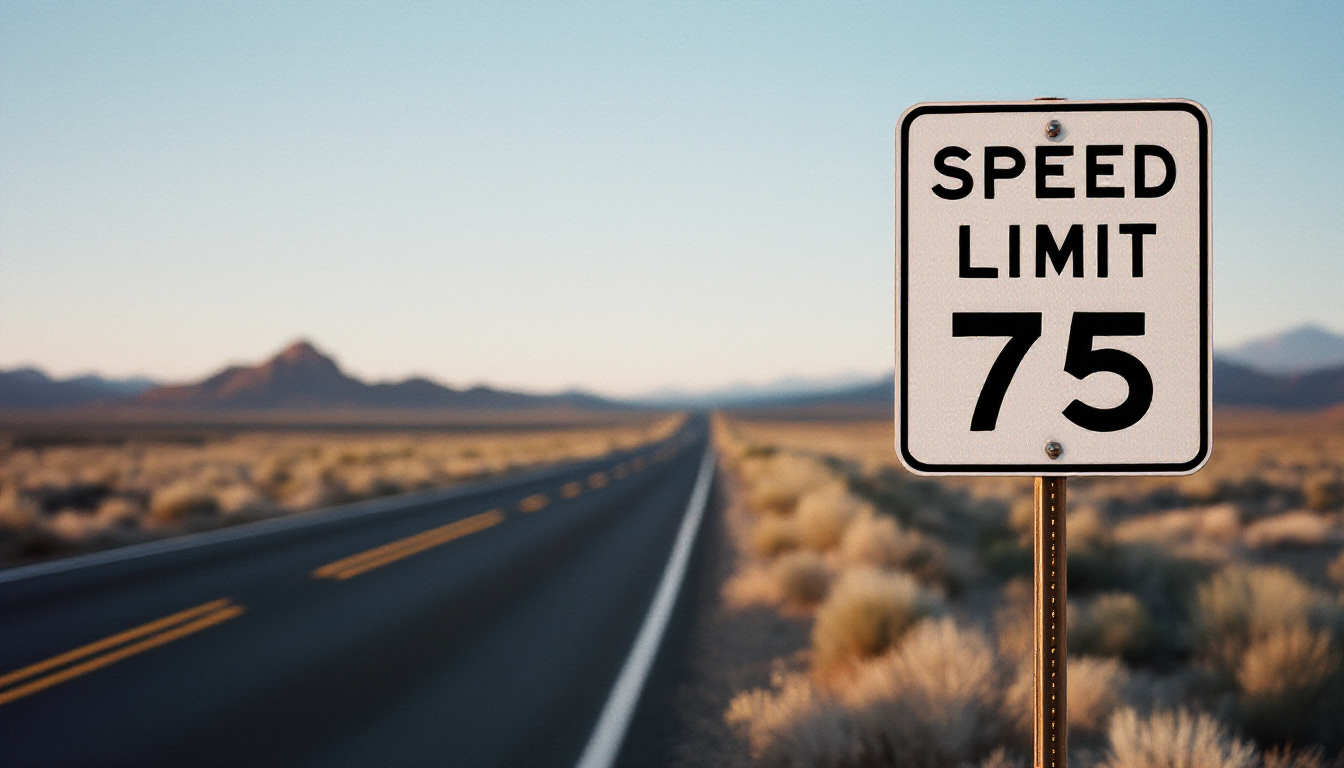
The US Manual on Uniform Traffic Control Devices (MUTCD), Chapter 2B, defines speed-limit signs.[2]The classic design: white rectangle, black "SPEED LIMIT" text at the top, a large black number below. The number is always miles per hourin the continental US.
- Yellow diamond with a black number = advisory (recommended) speed for a curve or ramp. Not a hard regulatory limit, but exceeding it is evidence of unsafe speed.
- "MINIMUM SPEED" sign = you must not drive slower than this (common on Interstates, often 40 mph).
- "FINES DOUBLE IN WORK ZONE" / school zones = enforced rigorously; penalties are multiplicative.
- Variable message signs = digital signs can legally lower the posted limit for weather, traffic, or incidents.
Typical posted limits by context
| Context | Typical mph | Notes |
|---|---|---|
| Rural Interstate | 65–85 | Texas SH 130 posts 85 mph — the highest in the US. Most western states sit at 75–80 mph rural. |
| Urban Interstate | 55–70 | Lower in dense metros (NYC, DC, SF). States often drop 10 mph at urban boundaries. |
| Rural 2-lane highway | 55–70 | Passing/no-passing zones and curves may post lower advisory speeds (yellow sign, not enforceable unless regulatory). |
| Residential / neighborhood | 20–30 | Unposted residential default is 25 mph in most states; some cities have moved to 20 mph. |
| School zone (when children present or flashing) | 15–25 | Strictly enforced. Passing a stopped school bus with flashing red lights is illegal in all 50 states. |
| Business district | 25–35 | Definition varies; signs control. |
Rural Interstate maxima — highest first
| State | Max mph | ≈ km/h | Where |
|---|---|---|---|
| Texas | 85 | 137 | SH 130 toll road only; most rural I-roads 75–80. |
| Idaho | 80 | 129 | Selected rural Interstates. |
| Wyoming | 80 | 129 | Selected rural Interstates. |
| Utah | 80 | 129 | Selected rural Interstates. |
| Nevada | 80 | 129 | I-80, I-15 rural. |
| Montana | 80 | 129 | Rural Interstates; lower overnight for trucks. |
| South Dakota | 80 | 129 | |
| Maine | 75 | 121 | Selected rural sections. |
| California | 70 | 113 | Rural Interstates; 65 urban. |
| New York | 65 | 105 | Rural Thruway; 55 in NYC. |
These are posted maxima under state law. Actual maxima on any given road segment may be lower where a specific sign is posted. The posted sign is the law. State-by-state detail: state comparison.
School-zone and construction-zone speed limits
Two categories are enforced hard:
- School zones — usually 15–25 mph, posted with fluorescent yellow-green pentagons, active when children are present or when a specific flashing yellow beacon is lit. Fines are multiplied in many states.
- Work zones — orange diamond signs indicate a work zone; the posted limit applies whether or not workers are visible. "Fines double" is a common multiplier. Hitting a worker is a felony in most states.
Speeding enforcement — what to expect
US speeding enforcement is a mix of stationary radar, moving radar, LIDAR, aircraft, and — increasingly — automated speed cameras in some states. Rules for "speed traps" and the maximum shown on radar are state law. Automated camera enforcement is legal only in states that have enabled it (for example Arizona, Maryland, and DC have extensive programs; Texas largely prohibits them).
If pulled over, see our step-by-step guide: if police stop you.
Related
Sources
- [1]FHWA — Speed Limit Basics — FHWA · accessed 2026-04-23
- [2]FHWA MUTCD — Chapter 2B (Regulatory Signs) — FHWA · accessed 2026-04-23
- [3]NHTSA — Speeding — NHTSA · accessed 2026-04-23
- [4]TxDOT — TxDOT · accessed 2026-04-23
- [5]California DMV — Driver Handbook — California DMV · accessed 2026-04-23